
You are about to approve a swap on a Layer 2 network. The token amount looks familiar, the gas fee is acceptable, and the dApp appears legitimate. Then the wallet shows something less reassuring: a warning that the transaction may change your balances in ways you did not expect. That pause is valuable. In DeFi, the most dangerous transaction is not always the one with an obviously high fee; it may be the one whose consequences are hidden behind a routine-looking approval or contract call.
This is where transaction simulation becomes more than a convenient feature. In the rabby Chrome extension, a proposed transaction is simulated before signing so that expected balance changes and potential risks can be displayed. The important point is not that simulation makes a transaction “safe” by itself. Its real contribution is to convert opaque smart-contract instructions into a decision a human can inspect.
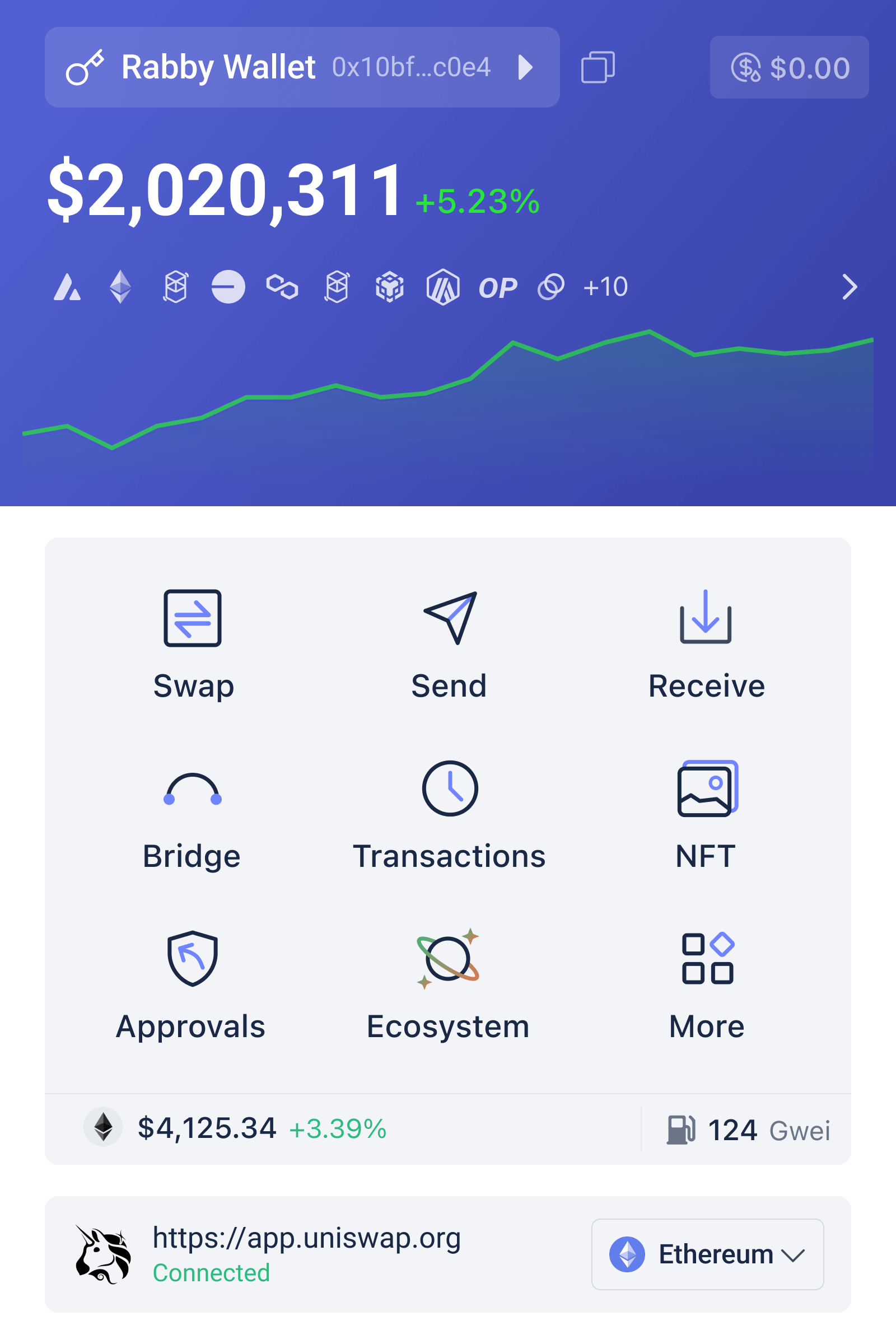
What transaction simulation actually does
A blockchain transaction is normally presented to a user as a technical request: call a function on a contract, send a value, or approve a spender. The wallet may know the destination address and the encoded data, but that information is difficult for most people to interpret directly. A simulation instead asks an available blockchain environment what would probably happen if the transaction were executed under the current conditions.
For a DeFi user, the output can be much more useful than raw contract data. A simulated result may indicate that one asset leaves the wallet, another arrives, an approval changes, or a contract interaction produces an unexpected balance effect. This is a crucial conceptual distinction: the feature does not merely check whether a transaction is technically valid. It attempts to show the economic effect of the action.
That distinction matters because many attacks exploit the gap between technical validity and user intent. An unlimited token approval can be accepted by the network without an error while granting a spender broad authority over a token balance. A phishing dApp may request a signature that appears connected to a harmless action but has a very different consequence. A security scanner can add warnings for known phishing patterns, suspicious addresses, reported exploits, or infinite approvals; simulation adds another layer by examining the expected result.
Myth versus reality: a simulation is not a guarantee
The common myth is that a successful simulation proves a transaction is safe. It does not. A simulation is a conditional forecast based on the state of the relevant network and the assumptions available to the wallet at that moment. Smart-contract state can change between simulation and inclusion in a block. Liquidity can move, an oracle value can update, a market can become highly volatile, or another transaction can alter the conditions on which the result depended.
There is also a technical boundary. The simulation depends on access to suitable network data and an execution environment that reflects the target chain. If the RPC endpoint is delayed, incomplete, or behaves differently from the node that ultimately processes the transaction, the displayed result may not perfectly match reality. This does not make simulation useless; it explains why it should be treated as evidence for a decision, not as an insurance policy.
Some risks are also social rather than computational. A malicious contract can behave normally during one interaction and become harmful later. A user can understand the displayed token changes but still overlook the identity of the contract, the duration of an approval, or the legitimacy of the website requesting the action. Simulation can reveal consequences more clearly, but it cannot establish that the user’s overall strategy is wise or that a protocol will remain trustworthy.
The practical rule is simple: read a simulation as “this is what the wallet expects under these conditions,” not “this transaction has been certified as safe.” If the result is surprising, stop. If it is unclear, do not sign merely because the transaction is urgent or the dApp claims that a price opportunity will disappear.
Why this matters more on a multi-chain wallet
Multi-chain activity increases both opportunity and cognitive load. Rabby is designed for EVM-compatible networks and supports more than 140 chains and networks, including Ethereum, Polygon, Arbitrum, Optimism, Avalanche, Base, and BNB Chain. That breadth is useful for users who move between ecosystems, but every additional chain introduces another set of contracts, gas assets, bridge routes, settlement assumptions, and phishing targets.
Automatic network switching can remove a common source of friction: manually selecting the network required by a dApp. Yet convenience should not be confused with verification. A wallet can switch to the correct chain while the connected website is still malicious, the contract is still unaudited, or the requested approval is still excessive. The best workflow combines automation with deliberate review of the chain, contract, asset leaving the wallet, asset expected in return, and approval scope.
Bridges make this even more important. An integrated route through a service such as LI.FI can make cross-chain transfers more accessible, but a bridge transaction may involve several contracts and steps rather than one simple transfer. The user should ask what is being sent, where it is expected to arrive, which token representation will be received, and what happens if one part of the route fails. A simulation may clarify expected balance changes, but cross-chain settlement can involve timing and operational dependencies that are not reduced to a single screen.
Rabby’s security model is layered, not magical
Rabby’s positioning as a non-custodial wallet means private keys are stored locally on the user’s device rather than sent to Rabby’s servers. That changes the trust model: the user retains control of signing authority, but also retains responsibility for device security, backups, phishing resistance, and recovery phrases. Open-source code under the MIT license supports independent inspection, although open source alone does not prove that every installed version is harmless or that every user has reviewed the code.
The wallet’s independence from its backend is another useful distinction. Rabby does not create or alter the user’s transactions, and core signing functions can remain available even if Rabby servers are unavailable. However, transaction analysis and simulation naturally depend on network information and supporting infrastructure. Signing autonomy therefore does not mean that every safety warning or simulation result can be produced without external data. This is a boundary worth understanding, particularly for users who assume that “non-custodial” means “risk-free.”
Hardware-wallet compatibility with Ledger, Trezor, and OneKey can strengthen the signing boundary by keeping key operations in a dedicated device. It does not remove the need to inspect what is being signed. A hardware wallet protects the key; it does not automatically make a deceptive contract call legitimate. In other words, key security and transaction comprehension solve different problems.
A reusable review process for DeFi transactions
For everyday use, a five-part review is more reliable than focusing on one warning colour. First, confirm the network and the dApp domain. Second, identify the contract interaction rather than relying only on the dApp’s button label. Third, inspect which assets leave the wallet and which assets should arrive. Fourth, examine approvals, especially permissions that are unlimited or remain active for a long time. Fifth, compare the result with your intention: does the simulated outcome describe the trade, deposit, withdrawal, or bridge action you meant to perform?
This process is especially helpful for swaps. Rabby’s integrated aggregator can compare routes involving decentralised exchanges such as Uniswap and 1inch, seeking competitive rates and lower slippage. But the best quoted rate is not automatically the best execution. Slippage, liquidity depth, price impact, route complexity, and contract risk all matter. A slightly worse price through a simpler and better-understood route may be preferable to a marginally better quote that introduces additional dependencies.
The Gas Account feature, which can allow fees to be paid with stablecoins such as USDC across networks, addresses a real usability problem: being unable to transact because the native gas token is missing. It also creates a new review point. Users should distinguish between the asset used to pay fees and the asset involved in the underlying DeFi action. Convenience can reduce friction, but lower friction may also encourage people to approve transactions without understanding them.
Rabby Points and other loyalty mechanics should be treated separately from security decisions. Rewards for swaps, gas top-ups, or referrals may make activity feel more engaging, but they should not influence whether a user interacts with a contract. Incentives can change behaviour; they cannot improve the underlying risk profile of a transaction.
What to watch as wallet interfaces evolve
The most important development is not simply that wallets display more warnings. It is whether they can present complex intent in a form users can reliably compare with what they meant to do. As DeFi becomes more cross-chain and transactions involve aggregators, bridges, approvals, and account abstraction-like workflows, the quality of explanation may matter as much as the number of supported networks.
A plausible next step is stronger intent-based review: instead of showing only a contract call, a wallet could help users evaluate a complete action such as “exchange this amount, keep approval limited, and receive at least this minimum.” Whether that becomes genuinely safer will depend on accurate state data, transparent route assumptions, and clear handling of uncertainty. The signal to watch is not promotional language about being the best wallet; it is whether users can understand what will happen, what could change, and which assumptions might fail.
FAQ
Does Rabby’s transaction simulation guarantee that a transaction is safe?
No. It provides an expected outcome based on current network state and available execution data. State can change before confirmation, and simulation cannot fully judge the honesty of a website, the future behaviour of a contract, or the security of the user’s device. Treat an unexpected result as a reason to investigate, not as proof that a familiar result is harmless.
Is a hardware wallet still useful when using transaction simulation?
Yes, because the two tools protect different parts of the process. Simulation helps interpret the proposed action, while a hardware wallet helps protect the private key during signing. Neither replaces the other. Even with Ledger, Trezor, or OneKey connected, review the network, contract, approvals, and expected balance changes before confirming.
Can transaction simulation work if Rabby’s servers are unavailable?
Core signing functions can remain available because Rabby does not hold the user’s private keys or create transactions on the user’s behalf. Simulation and security intelligence, however, require suitable blockchain data and supporting services. This is why backend independence and complete analysis should be understood as related but separate properties.
The strongest lesson is modest but useful: a wallet cannot make DeFi risk disappear, yet it can improve the quality of the moment before a signature. Transaction simulation is valuable because it turns a technical request into a visible hypothesis about economic consequences. For German-speaking users moving across Ethereum and many EVM networks, that extra layer of interpretation can prevent avoidable mistakes—provided it is used as a disciplined review tool rather than accepted as an automatic guarantee.