
What if the most important wallet feature is not the ability to sign a transaction, but the ability to make its consequences visible before signing? That question sits at the centre of modern DeFi security. A swap, bridge transfer, liquidity deposit, or token approval may appear simple in a browser window while triggering several contract calls on-chain. For users in Germany and elsewhere in Europe, where self-custody means accepting direct responsibility for assets, this difference matters. Rabby Wallet approaches the problem through transaction simulation, security warnings, and a multi-chain interface designed for EVM applications. The result is useful protection, but not an automatic guarantee of safety.
Rabby was developed by DeBank as a non-custodial wallet for DeFi users. Its private keys remain locally stored on the user’s device rather than being transmitted to Rabby’s servers, and its core signing functions are intended to remain usable even if Rabby backend services are unavailable. The browser wallet is positioned as an alternative to MetaMask, with particular emphasis on multi-chain navigation and pre-signing analysis. The recent Chrome Web Store description continues to present Rabby as an open-source Ethereum and EVM wallet built for a smoother multi-chain experience. That positioning is important, but the more revealing question is how its safety model works in practice.
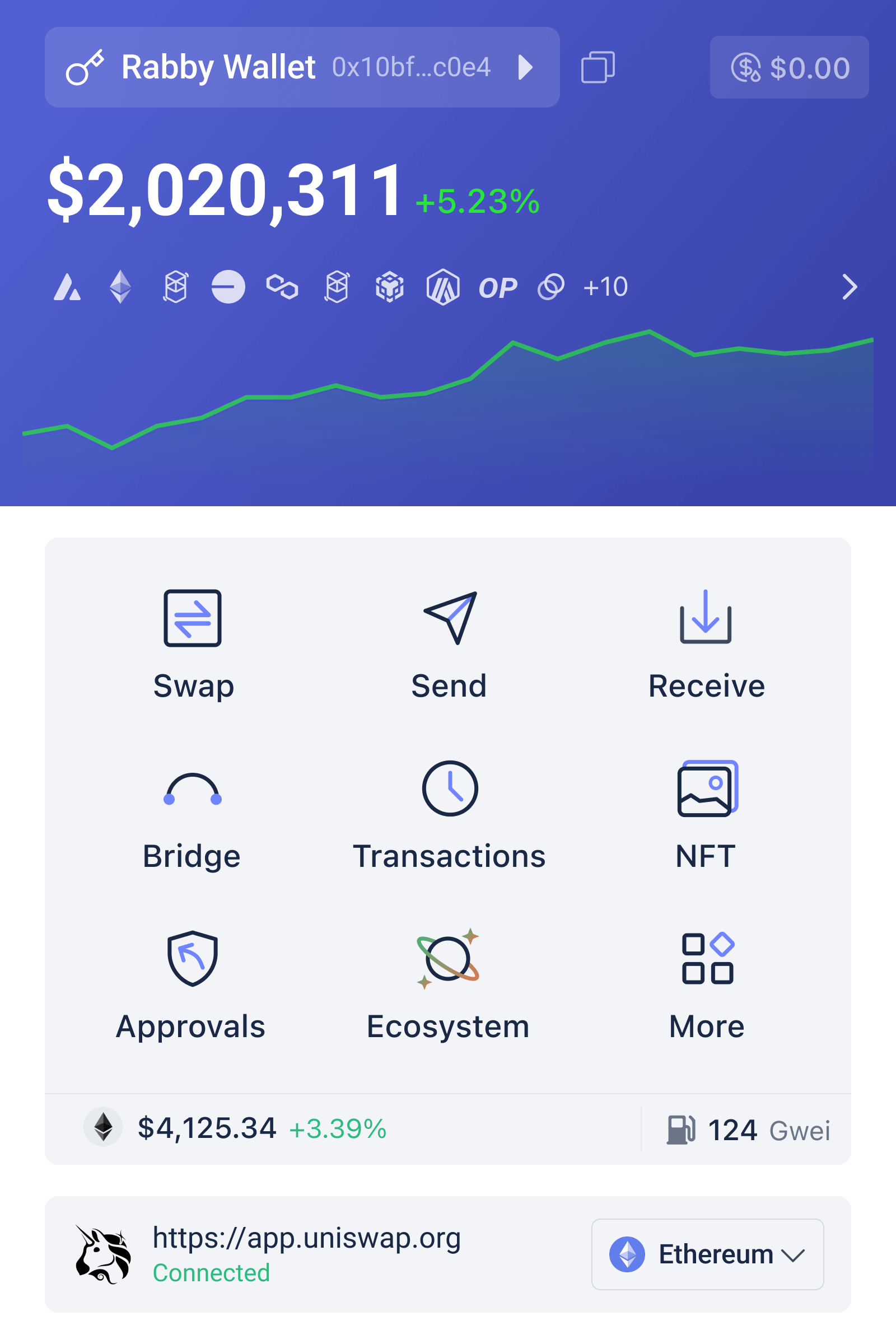
How transaction simulation changes the wallet decision
A normal wallet can show the destination address, the requested network, and perhaps a technical message from a smart contract. Transaction simulation adds another layer: before the user confirms, Rabby attempts to estimate what the transaction is expected to do and presents the resulting changes to token balances. In practical terms, the user may see that one asset is being spent, another is expected in return, an approval is being granted, or a balance is being transferred to a contract.
This is more than a cosmetic interface improvement. Blockchain transactions are instructions, not descriptions written for humans. A decentralised application may ask a wallet to sign a structured message or contract call whose consequences are difficult to infer from raw calldata. Simulation translates at least part of that instruction into an anticipated state change. The sharper mental model is therefore this: Rabby acts as a pre-flight inspection layer, not as an authority that decides whether a transaction is morally or financially sound.
That distinction is especially important for token approvals. An approval can allow a contract to spend tokens on the user’s behalf. When the allowance is unlimited, the immediate transaction may cost little, yet the permission can remain a substantial future risk if the contract is compromised or misused. Rabby’s security engine checks for risks including phishing, known hacks, and infinite approvals, while simulation can make the expected balance and permission changes more legible. Users should still ask whether the approval is necessary, whether the spender is the intended contract, and whether a limited allowance would better match the use case.
Rabby and MetaMask: similar foundations, different emphasis
Comparing Rabby with MetaMask is not simply a contest between two browser extensions. Both belong to the non-custodial wallet category, where the user controls the keys and signs interactions with decentralised applications. The meaningful comparison concerns workflow. MetaMask became a widely recognised gateway to Ethereum and later expanded across multiple networks. Rabby was designed with a more explicit DeFi and multi-chain orientation, including automatic network switching, transaction simulation, and integrated risk warnings.
For a user moving between Ethereum, Polygon, Arbitrum, Optimism, Avalanche, Base, BNB Chain, and other EVM-compatible networks, automatic network recognition can remove a frequent source of friction. Rabby supports more than 140 EVM networks according to the provided project information. That breadth is convenient, but it also creates a trade-off: the more networks a wallet exposes, the easier it becomes to lose track of which chain holds an asset, which contract is being used, and which fee market applies.
Rabby’s integrated swaps scan decentralised exchange venues such as Uniswap and 1inch, while bridge functionality includes protocols such as LI.FI. A Gas Account can allow fees to be paid with stablecoins such as USDC across networks, reducing the awkward situation in which a user owns the intended asset but lacks the chain’s native token for gas. These features improve operational efficiency. They do not remove market risk, bridge risk, slippage, smart-contract risk, or the possibility that a displayed route is unsuitable for a particular transaction size.
In this context, the rabby wallet extension is best understood as a control surface for complex activity, not as a substitute for checking the underlying protocol. A better interface can reduce avoidable mistakes, but convenience may also encourage users to approve transactions faster. Security design must therefore be paired with deliberate pauses, particularly when funds move through a bridge or when a new dApp requests broad permissions.
What simulation can reveal—and where it can break
Simulation is powerful because it models an expected outcome before the transaction is broadcast. Yet it is not an oracle. The simulated result depends on the state observed at that moment, the availability and accuracy of the relevant data, and the assumptions of the simulation environment. Blockchain state can change between simulation and inclusion in a block. A liquidity pool may be traded against, a contract may respond differently under changed conditions, or a transaction may be reordered in a way that affects execution.
Some risks are also difficult to compress into a balance-change panel. A contract can behave differently depending on the caller, block conditions, or a later interaction. A malicious application may use a plausible-looking operation to obtain a dangerous signature. A bridge may complete one side of a transfer while the broader system remains exposed to operational or contract failure. Simulation can expose expected asset movements, but it cannot turn an unaudited protocol into a safe one.
The practical consequence is a two-stage decision process. First, inspect the simulated effects: which tokens leave, which tokens arrive, which permissions change, and whether the network and recipient are correct. Second, evaluate context: is the dApp genuine, is the contract expected, is the route appropriate, and can the potential loss be accepted? The first stage detects transaction-level surprises; the second addresses protocol-level uncertainty. Confusing these stages is one of the most common misconceptions around wallet security.
Self-custody, open source, and hardware signing
Rabby’s non-custodial model means that responsibility remains with the user. Local key storage reduces the need to trust a wallet provider with private keys, but it does not protect against malware, a compromised browser profile, a fraudulent recovery phrase request, or careless signing. Open-source software released under the MIT licence enables community inspection of the code, which is a meaningful transparency property. It is not, by itself, proof that every deployment, dependency, update, or user environment is risk-free.
Hardware-wallet compatibility with Ledger, Trezor, and OneKey adds a separate security boundary. The private key can remain within the hardware device while Rabby prepares and displays the transaction. This is particularly useful for larger balances or long-term holdings. However, hardware signing does not make a malicious transaction harmless. If the user confirms the wrong recipient, approves an unsafe contract, or misunderstands a bridge route, the hardware device may securely sign the wrong action. Simulation and the hardware display should be treated as complementary checks.
Rabby Points, earned through activities such as swaps, gas funding, or referrals, introduce an incentive layer. Such programmes may increase engagement, but users should not let loyalty rewards determine risk decisions. A small prospective benefit cannot rationally justify an unlimited approval, an unfamiliar bridge, or a transaction whose simulated effects are unclear. In financial interfaces, incentives deserve the same scrutiny as fees: they can change behaviour even when they do not change the underlying risk.
A reusable checklist for German DeFi users
Before signing in Rabby, begin with identity rather than speed. Confirm that the dApp domain is the intended one, that the selected account is correct, and that the network matches the action. Then read the simulation as a balance sheet: identify outgoing assets, incoming assets, approvals, recipients, and any unexpected change. If the result cannot be explained in plain language, stop.
Next, separate reversible from irreversible decisions. A rejected transaction usually costs nothing or little, while a confirmed transfer or approval may be impossible to undo. Review slippage for swaps, the recipient on bridges, and the scope of token permissions. If the amount is material, use a hardware wallet and consider testing with a smaller transaction first. Keep a record of which chain and address were used; multi-chain convenience can otherwise create accounting and tax-reporting confusion, including questions relevant to German users.
Finally, treat warnings as evidence, not as a complete verdict. A warning deserves investigation, but the absence of a warning is not a certification. The strongest workflow combines simulation, contract and dApp verification, limited approvals, hardware signing where appropriate, and disciplined key management. If Rabby’s servers are temporarily unavailable, its stated ability to keep core signing functions available is useful, but service independence does not eliminate the need to understand what is being signed.
What to watch next
The direction of wallet design is clear: raw contract calls are gradually being supplemented by intent-oriented explanations, risk signals, and cross-chain automation. If these systems become more accurate and transparent, users may spend less time managing networks and more time evaluating economic and contractual risk. The condition is crucial. Better automation must preserve an inspectable record of what will happen, rather than hiding complexity behind a single confirmation button.
For Rabby, the most meaningful test is not how many chains or integrated services it supports, but whether its warnings remain understandable as transactions become more composable. A wallet that can show expected effects across swaps, approvals, bridges, and gas funding offers genuine educational value. The unresolved issue is how reliably those effects can be represented when protocols, markets, and blockchain state change rapidly.
Frequently asked questions
Does Rabby transaction simulation guarantee that a transaction is safe?
No. Simulation shows expected effects before signing and can reveal suspicious balance changes or permissions, but it depends on available state and cannot eliminate smart-contract, bridge, phishing, market, or device-security risks.
Is Rabby safer than MetaMask?
It is more accurate to say that Rabby emphasises different safeguards, particularly multi-chain workflow, transaction simulation, and integrated security warnings. Safety still depends on the user, the dApp, the contract, key management, and the specific transaction.
Why use a hardware wallet with Rabby?
A compatible hardware wallet can keep private keys isolated from the computer while Rabby handles the dApp connection and transaction preparation. It strengthens key protection, but users must still verify the transaction and approve only actions they understand.
Can Rabby pay gas fees with stablecoins?
Its Gas Account feature is designed to let users pay network fees with stablecoins such as USDC across supported networks. Availability and conditions can depend on the relevant network and service configuration, so the displayed fee details should be checked before signing.