
Many DeFi users assume the difficult part of using several blockchains is remembering different networks. In practice, the more consequential problem is deciding what a transaction will do before signing it. A wallet may hold the same kind of asset across Ethereum and several EVM-compatible networks, yet the meaning, cost, permissions, and risk of a transaction can differ sharply from one chain to another.
That is why choosing and installing a multi-chain wallet deserves more thought than simply finding a convenient Rabby extension download. The useful question is not only whether a wallet can connect to many networks. It is whether the wallet helps a user understand contracts, token approvals, gas requirements, and likely outcomes at the moment a decision is made.
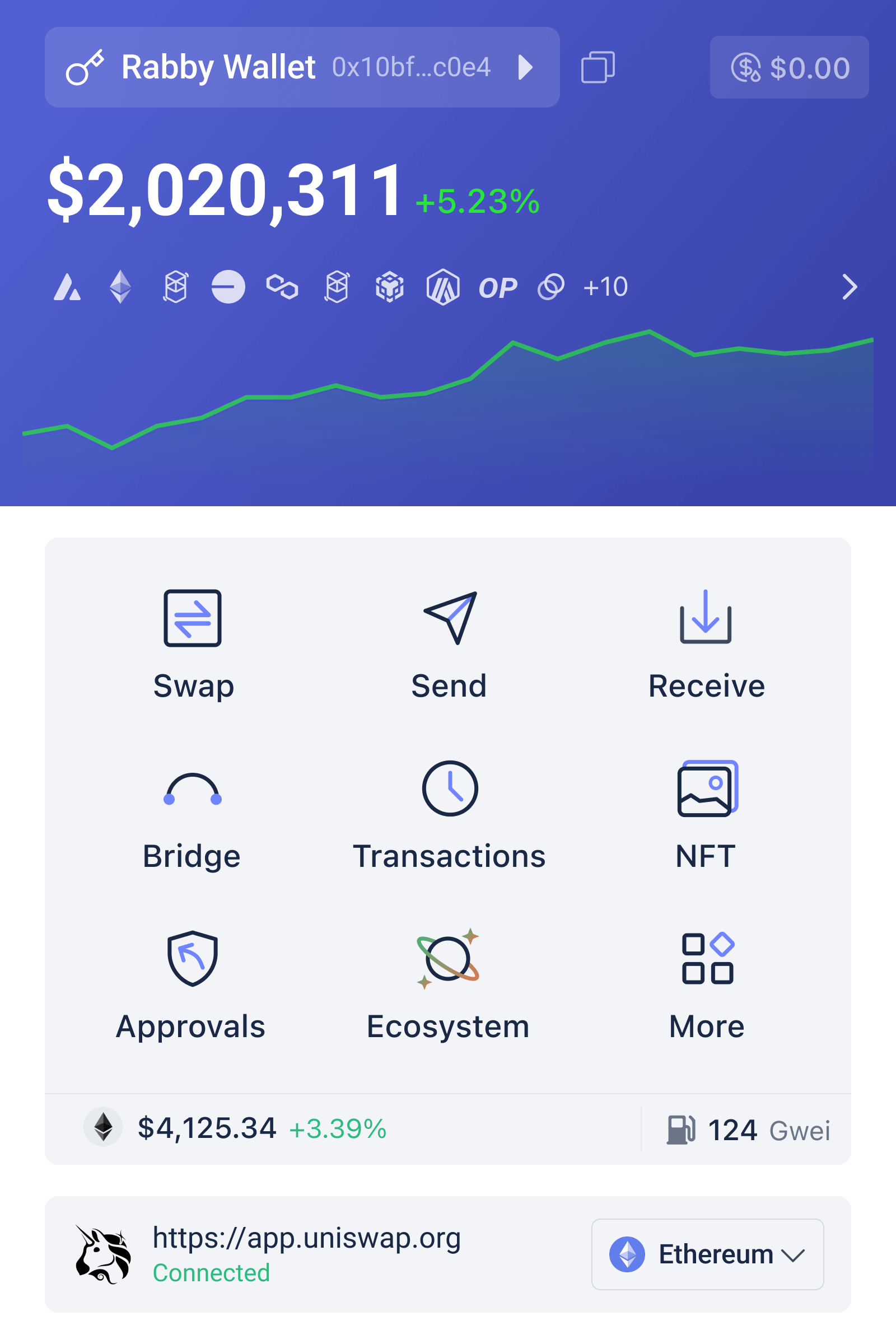
The practical case: one user, three chains, three different risks
Consider a US-based DeFi user moving through an ordinary Saturday. On Ethereum, the user supplies an asset to a lending protocol. Later, the same wallet is connected to a decentralized exchange on an Ethereum layer-2 network. In the evening, the user bridges funds to another EVM chain to pursue a lower-fee opportunity.
At the address level, this can feel like one continuous portfolio. Mechanically, it is not. Each network maintains its own state, native gas asset, transaction history, and deployed contract addresses. A token with the same ticker may represent a different contract on another chain. A familiar protocol name does not automatically mean that every deployment has identical code, liquidity, governance, or operational history.
This is the first important mental model: a multi-chain wallet is not a single universal account balance. It is an interface for managing related accounts and environments. The wallet can make those environments easier to navigate, but it cannot erase their differences.
Rabby’s positioning around Ethereum and EVM chains is relevant because EVM compatibility creates a common execution model. Users can generally work with similar address formats, signing flows, and decentralized applications across supported networks. That shared structure is valuable, especially for people who would otherwise maintain separate tools for each chain. But compatibility is a technical starting point, not a guarantee of equal safety.
What a wallet can show before the signature
The most important wallet function often occurs before a transaction reaches the blockchain. When a decentralized application asks for a signature, the user needs to distinguish among several actions: a message signature, a token approval, a contract call, and a transfer of value. These are not interchangeable.
A message signature may authorize an off-chain action or prove control of an address. An approval can give a contract permission to move a token later, sometimes up to a very large allowance. A contract call may exchange assets, deposit collateral, mint a token, or interact with a more complex sequence of functions. The visual surface of a website can make these actions appear simple, while the underlying permission model remains complicated.
A transaction-aware wallet attempts to translate technical call data into a more understandable description of the proposed action. That can help the user identify the token involved, the destination contract, the amount, and possible warnings. The benefit is not that the wallet predicts the future. The benefit is that it reduces the gap between what the application says and what the blockchain is being asked to execute.
Simulation is another useful mechanism. If a wallet can simulate a transaction against current chain conditions, it may reveal an expected balance change, a failure, or an unexpected asset movement before the user signs. Yet simulations have boundaries. They depend on the accuracy and timing of available state, may not capture every external event, and cannot make a malicious but technically valid contract safe. A successful simulation means “this call appears executable under these conditions,” not “this is a good investment.”
That distinction matters during volatile US trading hours, when liquidity can move quickly and a quoted swap may change between simulation, signing, and inclusion. Wallet warnings are decision support, not insurance.
Rabby compared with other wallet approaches
Browser-based multi-chain wallets
A browser extension is often the most convenient format for DeFi because decentralized applications can request connections and signatures directly in the browser. A wallet focused on Ethereum and EVM networks can reduce network-switching friction and make a user’s activity easier to organize.
The trade-off is concentration. A browser wallet is exposed to the security of the browser profile, the operating system, installed extensions, and the user’s own habits. If a malicious extension or compromised computer gains access to the wallet environment, the convenience of one-click signing becomes a liability. Users should therefore treat the extension as a signing surface, not as a substitute for endpoint security.
Hardware wallets
A hardware wallet separates private-key operations from the everyday computer. This can materially reduce the impact of some malware threats because the key is designed not to leave the device. For users holding significant value or signing infrequently, that separation is a meaningful advantage.
However, hardware protection does not solve every problem. A user can still approve a harmful transaction after reading it incorrectly, connect to a fraudulent site, or mishandle recovery credentials. Hardware wallets may also introduce more friction when switching networks or interacting with newer applications. A common practical arrangement is to use a browser wallet interface while routing high-value signing through a hardware device, provided the user understands which account is active.
Custodial exchange accounts
Keeping assets on a centralized exchange can be simpler for trading, fiat conversion, and account recovery. The exchange manages key custody and often provides a familiar interface. For a US user moving dollars into crypto, that convenience can be useful.
The sacrifice is control. The user does not directly control the private keys, and withdrawals may depend on the platform’s policies, compliance processes, operational status, and supported networks. A custodial account is therefore not equivalent to a self-custody wallet, even when both display a similar asset balance.
The choice is not a contest with one universal winner. Browser wallets fit active application use; hardware wallets strengthen key isolation; custodial accounts simplify certain onboarding and trading tasks. The right decision depends on transaction frequency, asset value, technical confidence, and tolerance for operational responsibility.
Installing the extension without turning convenience into exposure
For readers preparing a rabby wallet download, source verification should come before setup speed. Search advertisements, cloned websites, and look-alike browser extensions are persistent risks in crypto. Use the project’s official distribution path and verify that the extension publisher, domain, and requested permissions are consistent with the genuine product.
During setup, the recovery phrase is the most sensitive object in the process. It should be generated or imported only in a trusted environment, never pasted into a website, messaging app, cloud note, or screenshot. Anyone with the phrase can generally control the associated assets. A wallet password may protect the local installation, but it does not replace the recovery phrase or change the ownership model.
After installation, begin with a low-value test. Connect to a known application, confirm the active account and network, and inspect the proposed transaction before signing. Send a small amount before attempting a large transfer. This is not needless caution: it is a way to test the entire operational chain, including address selection, gas availability, network choice, and withdrawal compatibility.
Users should also distinguish between a token appearing in a wallet and a token being trustworthy. Token balances are records associated with contracts; displaying one does not validate the issuer, liquidity, redemption promise, or market price. Similarly, a warning does not prove that a transaction is malicious, while the absence of a warning does not prove that it is safe.
The multi-chain limitation most users underestimate
Cross-chain activity adds another layer of uncertainty. A bridge may lock, burn, mint, or otherwise account for assets across separate systems. The user may experience this as one transfer, but the process can involve multiple contracts, relayers, validators, message-passing systems, and waiting conditions. The security of the result depends on the weakest relevant component, not merely on the wallet interface used to initiate it.
There is also a portfolio-accounting problem. The same address format across EVM networks can encourage false confidence that funds are interchangeable. They are not interchangeable until the correct network, asset representation, liquidity venue, and withdrawal route are all available. A wallet can help display these distinctions, but the user still needs to check chain-specific details.
Recent messaging from Rabby continues to frame the product as a wallet for Ethereum and EVM chains. The practical implication is that users may increasingly expect one interface to coordinate a broad range of DeFi environments. If that expectation grows, the key feature to watch is not simply the number of supported chains. More decision-useful signals would include clearer transaction interpretation, reliable simulation, transparent warnings, and graceful handling of unfamiliar contracts.
Those capabilities could reduce avoidable signing mistakes if they remain understandable and accurate. The open question is how well any interface can keep pace with rapidly changing protocols, complex intent-based transactions, and applications whose risks are economic rather than purely technical.
A reusable decision framework for DeFi users
Before signing, ask four questions. Which network am I on? Which account is active? What exact permission or value transfer is being requested? What would I lose if the contract, price, bridge, or recipient were wrong?
Then match the tool to the transaction. Use a convenient browser interface for routine, low-value interactions only when the application and contract are understood. Consider hardware-backed signing for larger balances. Keep long-term holdings separate from the account used for experimental applications. Finally, record recovery information offline and maintain a clear separation between testing funds and core capital.
This framework is more durable than memorizing a list of wallet features. Multi-chain DeFi changes quickly, but the underlying questions remain stable: what is being authorized, on which state machine, through which contract, with what reversibility and what consequence?
FAQ
Is Rabby a wallet for every blockchain?
Rabby is oriented toward Ethereum and EVM-compatible networks. That makes it suitable for many DeFi environments using the EVM model, but it should not be assumed to support non-EVM chains or every application automatically. Confirm network and application compatibility before moving funds.
Does a wallet warning mean a transaction is definitely a scam?
Not necessarily. Warnings are signals based on available information and transaction characteristics. They can identify unusual behavior or known risks, but they may produce false positives and cannot detect every economic or governance problem. Treat them as prompts to investigate, not as absolute judgments.
Can a multi-chain wallet protect me from losing money in DeFi?
No. A wallet can improve visibility into signatures, approvals, and network context, but it cannot remove smart-contract risk, market volatility, bridge risk, phishing, or user error. Its strongest role is helping users make a more informed decision before authorization.
The best multi-chain wallet is therefore not simply the one that connects to the most networks. It is the one that helps the user maintain the right distinctions: account versus chain, display versus ownership, simulation versus certainty, and convenience versus control. Rabby can be useful within that model, but the final security boundary remains the person reviewing and approving the transaction.